
Today, as electronic products increasingly tend towards thinness, high performance, and intelligence, Surface Mount Technology (SMT) has become an indispensable core process in modern electronic manufacturing. From smartphones and wearable devices to industrial control and automotive electronics, the reliable placement of precision components directly determines the final performance, stability, and market competitiveness of electronic products. A deep understanding of the technical essentials and development trends of SMT chip placement technology is of great strategic significance for electronic companies to enhance product quality and optimize manufacturing costs.
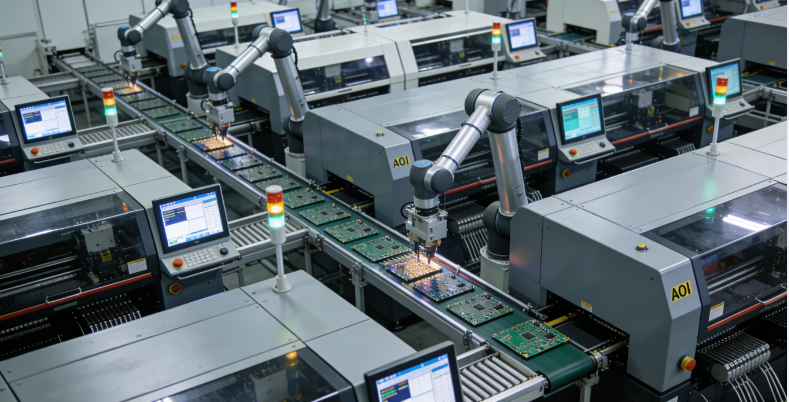
The core advantages of SMT technology
Compared to traditional Through-Hole Technology (THT), SMT technology offers revolutionary advantages. Firstly, SMT significantly enhances the assembly density of circuit boards. Since surface-mount components do not require reserved holes, they can be directly mounted on the surface of the PCB, greatly freeing up wiring space on the circuit board and providing technical support for the miniaturization and lightweight of electronic products. Secondly, SMT chip mounting technology is suitable for automated large-scale production. Fully automated pick-and-place machines can complete component mounting at extremely high speed and precision, achieving production efficiency tens or even hundreds of times higher than traditional manual insertion, significantly reducing the manufacturing cost per unit product. Furthermore, SMT soldering quality is more stable and reliable, with the reflow soldering process ensuring consistency in solder joints and reducing quality fluctuations caused by human factors.
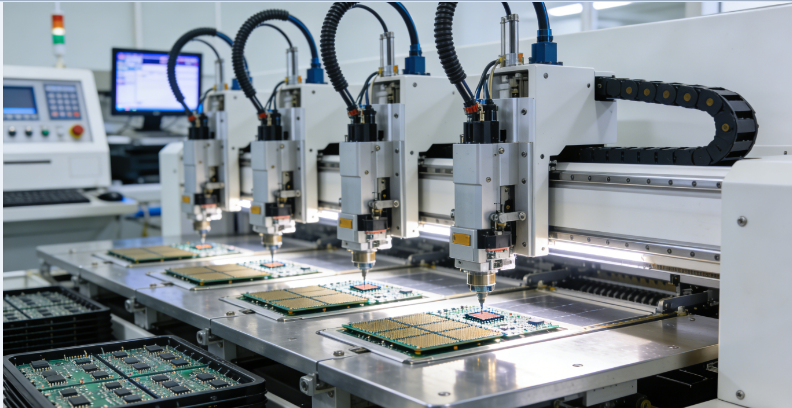
Technical key points of precision chip mounting
SMT accuracy is a key indicator for measuring the level of SMT technology. With the continuous shrinking of electronic component package sizes, micro components such as 01005 (0.4mm×0.2mm) and 0201 have moved from being high-end products to becoming widespread, posing unprecedented challenges to the SMT process. Modern high-speed pick-and-place machines are equipped with high-precision linear motors and linear encoders, combined with advanced visual alignment systems, capable of achieving ±15μm or even higher placement accuracy, ensuring that micro components can be accurately placed onto predetermined solder pad positions.
Solder paste printing is the first key process in SMT technology. The quality of solder paste printing directly determines the yield of subsequent placement and soldering. High-precision fully automatic solder paste printing machines, coupled with precision laser steel mesh, can accurately apply solder paste to PCB pads, with thickness errors controlled within ±25μm. To meet the placement requirements of micro components, steel mesh opening technology is also evolving. Nano-coating and electroforming processes make the steel mesh opening size more precise, with an area ratio down to 0.55, effectively solving soldering defects such as insufficient solder and cold solder joint in micro components.
Reflow soldering is the core process of SMT technology. Modern reflow soldering furnaces are typically equipped with multiple temperature zones, enabling precise control over the temperature profiles during various stages such as preheating, isothermal holding, reflow, and cooling. By optimizing reflow soldering temperature parameters, common soldering defects such as cold solder joint, insufficient solder joint, and bridge joint can be effectively avoided, ensuring that solder joints are full, bright, and reliable. For lead-free soldering processes, due to the relatively high melting point of solder, temperature control is more stringent. Measures such as nitrogen protection are required to reduce oxidation and improve soldering quality.
Quality inspection system
A comprehensive inspection system serves as a crucial safeguard for ensuring the quality of SMT (Surface Mount Technology) chip placement. Automatic Optical Inspection (AOI) equipment is capable of conducting real-time inspections at multiple critical stages, including after solder paste printing, component placement, and reflow soldering. It automatically identifies various defects such as missing components, reversed polarity, misalignment, standees, and insufficient solder, with a defect detection rate exceeding 99.99%. For concealed solder joints like BGA and QFN, X-ray inspection technology can penetrate the internal structure of the solder joints, analyzing issues like void ratio, cracks, and short circuits to ensure soldering reliability. Functional Testing (FCT) simulates real-world working scenarios to verify the power-on functionality of PCBA (Printed Circuit Board Assembly), covering key indicators like voltage, current, and communication protocols to ensure the product operates normally.
Technological development trend
Looking ahead, SMT (Surface Mount Technology) is continuously evolving towards intelligence, flexibility, and greenification. The deep integration of AI technology and SMT technology is transforming traditional production models. AI visual quality inspection identifies micron-level defects through deep learning algorithms, not only enhancing detection accuracy but also feeding back process optimization through data analysis, achieving a gradual curve towards "zero defects". The MES (Manufacturing Execution System) enables full-process traceability, with complete records of every step from materials to finished products, meeting the requirements of high-reliability industries such as automotive and medical.
The development of flexible manufacturing systems has enabled a single production line to handle multiple different products simultaneously, significantly reducing changeover time and adapting to the market demand for a wide variety and small batches. The modular equipment design allows for quick replacement of key components such as pick-and-place heads and feeders, making production more flexible and efficient. The concept of green manufacturing permeates the entire production process, with the application of environmentally friendly technologies such as lead-free solder, low-temperature solder paste, and nitrogen reflow soldering, effectively reducing energy consumption and emissions, and responding to the global goal of carbon neutrality.
As the core engine of electronic manufacturing, the technical level of SMT (Surface Mount Technology) precision chip mounting process directly affects the performance, quality, and cost of electronic products. With the rapid development of emerging technologies such as 5G, the Internet of Things, and artificial intelligence, the SMT process will continue to evolve, providing solid technical support for the innovative development of the electronics industry.
————————————————
Reproduced from the original article by CSDN blogger "SMT Patch Henan Xintu Electronics".
Original link: https://blog.csdn.net/hnxtdz/article/details/15728216
opyright © 2022-2026 Flexunion All Rights Reserved. Add:No. 28 Longshan Er Road, West District, Daya Bay, Huizhou, 6th Floor, Building 6, Daya Bay Science and Technology Innovation Huizhou Software Park 粤ICP备2026018540号